The Sandbox Director James Thoo On Making A Mockumentary About SMEs, His Michael Mann Influence And The ‘Jack Neo Effect’
The Singapore-based British filmmaker’s directorial debut, The Sandbox, follows a struggling stunt school and the price of chasing dreams.


“I get knocked down, but I get up again,” so goes the chorus of Chumbawamba’s ‘Tubthumping’.
It’s a line swirling in my head as I’m thinking of James Thoo, the writer-director of The Sandbox, in cinemas Oct 8.
He knows something about getting knocked down — literally and figuratively.
After all, he had a stint as a professional boxer amid a Hollywood screenwriting career spanning more than two decades. (NDAs prevent Thoo from revealing much about his script-doctoring days. Here’s a hint: he did some rewrites for a director who shares the same first name as yours truly.)
With The Sandbox, the 41-year-old British filmmaker’s theatrical feature debut, he turns his attention to another group accustomed to taking a hit: stunt performers.
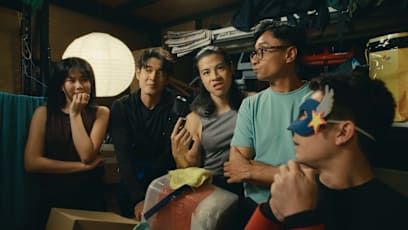
The independently financed mockumentary follows stuntman Peps (real-life action director and stunt coordinator Peps Goh), his best friend John (Jon Cancio) and John’s ex-wife Min (Oon Shu An) as they struggle to keep their stunt school alive.
Their fortunes suddenly improve when news that Marvel Studios is scouting locally sends wannabe superheroes flocking through its doors. (Sounds farfetched? Not really. Marvel once held an extras casting call for background actors of Southeast Asian descent to appear in Captain America: Civil War.)
The ensemble also includes Benjamin Kheng, Nathan Hartono, Estelle Fly, Xuan Ong, Fauzi Azzhar and Aaron Mossadeg.

Don't mess with them: (from left, seated) Peps Goh, writer-director James Thoo, Tiffany Yong, (from left, back row) Nathan Hartono, Fauzi Azzhar, Estelle Fly, Aaron Mossadeg, Oon Shu An, Xuan Ong, Jon Cancio, Andrew Marko, and Benjamin Kheng. (Photo: Mocha Chai Laboratories)
Beneath the awkward pratfalls and superhero poses, however, is a bittersweet story about dreamers trying to pursue what they love while economic reality keeps holding them back.
Born in England to an English mother and a Malaysian-Chinese father, Thoo moved to Kuala Lumpur when he was around 12 after his father landed a job there. He later returned to the UK for university, where he studied Russian history (more on that later), and started writing for movie website JoBlo when he was about 19.
He eventually met his Singaporean wife, an exec at a shipping company, at a club here. They married and Thoo moved to Singapore, where they now live with their two daughters.
But the roots of The Sandbox go back to Malaysia.
Some 15 years ago, Thoo’s younger brother relocated there to pursue professional boxing, with Thoo as his coach. When it became apparent that boxing couldn’t provide his brother with a sustainable living, they opened a gym together despite knowing little about running a business.
That experience formed the DNA for The Sandbox. “I was the John to his Peps,” Thoo writes in his director’s notes.
Years later, meeting Goh made Thoo realise they had something else in common: both had devoted themselves to crafts they felt weren't necessarily valued in Singapore.
“We were both people who had kind of devoted our lives to this craft and then found ourselves in a place that didn’t particularly necessarily value that craft,” Thoo tells 8days.sg.
“Me with writing and Peps with stunt choreography,” he says. “So it was definitely very top of mind that this film was about me in a lot of ways.”
And then came another knock: the real Sandbox Training Ground closed, eerily mirroring the struggles depicted in a screenplay Thoo had completed years earlier. He calls the coincidence an “unhappy accident”.
8days.sg spoke to Thoo about getting punched in the face, making movies with limited resources, his Michael Mann obsession, pursuing an artistic career in Singapore and, appropriately enough, getting back up again.
8days.sg: You were a boxer and now you’ve made a movie about stunt performers who take punches for a living. What does getting punched teach you about directing actors that film school probably didn’t?
I think boxing, getting punched in the face a lot, forces that kind of endurance, I guess — endurance for punishment and discomfort — that is necessary for a lot of the stuff with directing.
There was a very specific experience that was one of the biggest learning experiences for me on The Sandbox. The scene involves Min's [Oon Shu An’s character] and it takes place in her HDB flat.
When we shot that, for some reason there was no air-con in that apartment. It was so hot, dude.
The cast was like 10 people, the crew was another 10 or 15, and they’re just packed in this room. They would quickly do the take and then quickly go to a room where there was a fan.
I knew that we didn’t get the shot. When they’re sitting around the table, there was a specific way that I wanted to get it.
After about 12 or 13 takes, I knew we didn’t have it.
I was looking at all the actors thinking, they’re putting so much faith in me and doing this film for much less than they deserve to be paid. It was late, about one in the morning, and I didn’t have the heart to be like, “All right, guys, let’s go. Take 16.”
I wrapped it knowing that we didn’t get it exactly how I wanted. When I told them later, every single person was like, “Dude, you should have just told us. We would have gone all night. We wanted to get it properly.”
I entered thinking I’m the only one who can tank all of the hardship of making the film, but I realised actually everybody in the arts at that level just really wants to make good stuff, and they’re equally willing to endure hardship.
So I guess that’s a weird way of saying that boxing actually taught me nothing. (Laughs) It gave me a false sense of strength that I didn’t have, really.

Risky business: Writer-director James Thoo (right), in his lucky Heat T-shirt, sets up a shot with cinematographer Michael Edo Keane. (Photo: James Thoo)
You posted on Instagram a picture of you on the set of The Sandbox, wearing a Heat T-shirt. Were you trying to summon Michael Mann on set? Is he on your Mount Rushmore of filmmakers?
Yeah, 100 per cent. Michael Mann is my favourite director. Heat is my favourite movie. It’s an old shirt. I wore it for good luck on the first day of shooting. Yeah, he 100 per cent would be on my Mount Rushmore.
What aspect of Michael Mann were you trying to channel in The Sandbox?
I would say that I hope to be able to make more Michael Mann-esque films in the future.
The nature of this film… I directed it in the way that I felt it needed to be directed. It’s a bit more broad than a Michael Mann film.
Michael Mann is somebody who I always find — the way he writes his dialogue is so kind of authentic. It is hyper-stylised, but it is very authentic.
Michael Mann’s all like serious men doing serious business, right? Especially the argument scene that Peps and John have, I tried to channel that.
It would be a lie to say that this is a very Michael Mann film, sadly. We knew going in that it was going to be a broader comedy.
Hopefully I get to make a more Michael Mann film in the future.
What were your influences for the mockumentary style?
Obviously, Christopher Guest, but I tried not to — because the truth is I don’t really like mockumentary.
The only reason why the film is a mockumentary is because I didn’t have any money. I didn’t have any resources, especially when we first conceived of this idea.
It was more just like, I want to make a film. What’s a way that we can construct it such that if we don’t get the best cameras or we struggle with continuity, there can be allowances for mistakes and stuff like that?
And so that’s why it became a mockumentary. In terms of influences, we watched a lot of What We Do in the Shadows, which is TV obviously.
But it was definitely a lot of Spinal Tap, Zelig…
And The Office?
Yes, but actually The Office was something that my DP [Michael Edo Keane] and I really tried to resist watching.
One of my guiding principles for film is that characters in a comedy should not know that they’re in a comedy. They should think they’re in a drama and vice versa.
To me, one of the issues with, let’s say generally speaking, broader comedies is that the actors, in my opinion, play it like they know they’re in a comedy. They kind of sell those zingers and stuff like that.
I was really trying to push against that. For Joash [Benjamin Kheng’s character], the only thing I asked him to watch was Big Trouble in Little China because I wanted him to play it like — if you watch that movie, Kurt Russell thinks that he’s the main character of this adventure, but he’s really not.
He’s just kind of bumbling around, not really doing anything. That’s how I wanted him to approach the film.

Praying for a miracle: (from left) Jon Cancio, Oon Shu An, and Peps Goh struggle to keep their stunt school afloat. (Photo: Mocha Chai Laboratories)
You mentioned in the press kit about an accidental moment where the camera appears in frame and audiences laugh at it. Does it sting when something accidental gets a bigger laugh than something you planned?
No, but when we had a screening in KL at the Malaysian International Film Festival, the biggest reaction was — there’s a brief shot at the end where Fauzi’s character is holding a cat.
Everybody was just like, “Aww,” at the cat. It was the biggest emotional reaction for the whole film.
That stung, because it was just a guy with a cat. (Laughs)
I’ve seen the film so many times now, going through the editing and screenings and stuff like that. The stuff that I wrote — there are some jokes that I still like — doesn’t really make me laugh anymore.
Now the stuff that makes me laugh is mostly improvisations, and I love that. There’s a bit where Aaron Mossadeg’s character does the worm and then off-screen you can hear Xuan go, “Ew.”
Just an improvisation. That’s one of my favourite bits and I don’t feel precious over that. I just want people to enjoy the film, so I don't care where the laugh came from.
The characters in The Sandbox want to become superheroes. While you were making it, did you ever think: I’m one of these characters — I’m pursuing my own fantasy of making a film?
Yeah. A big part of why the film came together is because I had always wanted to write something about my personal struggle, I guess, or journey through my career.
I was a screenwriter for like 20 years before this. The problem is that I always felt writing is inherently not cinematic.
Then I met Peps and I realised that we had a very, very, very similar perspective, similar struggle. We were both people who had kind of devoted our lives to this craft and then found ourselves in a place that didn’t particularly necessarily value that craft. Me with writing and Peps with stunt choreography.
That was a catalyst because it made me realise, “Oh, I can actually tell my own story,” but just kind of lean on the dynamism of his field, which is people falling off buildings, doing flips and stuff like that.
So it was definitely very top of mind that this film was about me in a lot of ways.
You and your brother started a boxing gym. You said earlier that The Sandbox is partly your story. Does that make you John?
In a lot of ways, actually, I am John in The Sandbox...
At some point pursuing the dream becomes worrying about rent, proposals and logistics. Does turning your passion into work kill some of the fun?
For myself, because we’re working on my next film now, I had this realisation a few weeks ago. I said to my producer, Anthony, “Dude, I don’t even write anymore.”
I just spend most of my time doing proposals and trying to pitch for sponsorships and stuff like that. That part is really not fun.
But it’s unfortunately an essential part of what goes into filmmaking here. The months that I spend writing, I really treasure. The two or three weeks on set is so much fun.
I really love editing, seeing the film come together. But in the grand scheme of things, most of the time is spent just trying to raise money. That is really not fun. And, to be honest, it's starting to get to me.
The real Sandbox has closed. Do you think Peps’ story could make a straight documentary? Would you want to make it?
It’s a very interesting question. Over the course of this press tour, Peps has been, I would say, quite jaded. Not with the press, but with the local industry scene.
He said something at a Q&A. He said it was kind of surreal to watch because, on the one hand, he was observing the version of himself from when we met and when I wrote the script like two or three years ago.
He was very hopeful then. And now he’s at a point where he’s, I would say, relatively hopeless.
I think his plans are, since the school’s been closed down, to leave Singapore. His story is very interesting, very compelling and, in a way, tragic.
In a weird way, I feel much less interested in this part of his story because I remain very hopeful for the local scene. He has lost all hope for now. And so I don’t want to tell that story. I want to tell hopeful stories because I really believe that we can make great films here even if we don’t have the budgets.
Look, maybe five years from now I'll be exactly where he is and he'll be proven correct. But I would say for now, I remain hopeful.

Quick picks: James Thoo's favourite Singaporean movies include (1) Dream Stall, (2) Shirkers, (3) Amoeba, and (4) Ilo Ilo. (Photos: GV Pictures, Netflix, Akanga Film Asia, Giraffe Pictures)
Like The Sandbox, Annette Lee’s Dream Stall, which came out a few months ago, is also about the struggles of running a small business in Singapore. What do you think gets lost when it comes to understanding the struggles of SMEs?
I wouldn’t say necessarily it's my problem with Singapore, but I think it’s the one thing — or the main thing — that I kind of don’t… I come from a very blue-collar background. We didn’t have much money when we were growing up.
Coming to Singapore, the most jarring thing to me was the primacy that financial prosperity had and how much everything seems to be prioritised about how much money it can make.
I wish that culture was prioritised to the same degree. Not in a kind of exhibitionist way, like the National Day Parade, which seems to be taken extremely seriously, but more of a kind of organic, street-level way.
The hawkers, the small businesses — I wish they were equally prioritised. I would never presume to understand how governance works or how I could make that better, but it’s a little confusing to me that there’s no kind of rent control at all to help.
I don’t really believe, to be honest, in helping somebody just because they’re local or they’ve been there a long time, but I feel like there should be some level of support for elements of culture.
I think if the rent just continues to escalate and only economies of scale or franchises that are from overseas can afford to pay the rents, then the only logical outcome is that hawkers are gone and all kind of local small-business entities are gone.
And is that what the government wants? Is that what we want? I would like to believe that it’s not the case, that they don’t actually want that.
I was talking to my wife yesterday saying that we should bring our kids to hawker centres way more because I don’t even know if they’re going to be there for much longer.
I just wish there was a bit more support for those small local businesses that define whatever is considered to be Singapore's unique local culture.
What Singapore films and filmmakers have stood out to you?
Shirkers. Shirkers is the best, right? Amoeba was pretty good, I thought. Ilo Ilo, I really loved. Wonderland, I thought was pretty cool.
I actually appreciate Dream Stall as well, to be honest. I think it’s a very difficult task that Annette had to write, direct herself in her first movie.
What about Jack Neo?
Okay, this is my position on Jack Neo. I am a Jack Neo supporter.
I feel like every time that I talk to a local artist in the film industry, they s*** on Jack Neo. “He’s the worst. His films suck. He’s a waste of time, waste of money.”
But his films have an audience. And his films are commercially viable. I feel like that’s not easy. You have to at least give him credit for that. He has an audience.
My wife’s family, who are not into the arts at all, love his films.
They might suck. I don’t know. (Laughs) I mean, I don’t really like the films, but I feel like you have to respect the person that’s found an audience.
It’s just so easy to feel like you’re the next Wong Kar-Wai and you make your film and it loses 80 per cent of its budget — “But I’m an artist” — but then to s*** on somebody who is actually satisfying an audience, I don’t understand that.
I feel like you must respect what he’s doing. I would say that when I’m on this grind now trying to raise funds for the next film, in a way, he has actually made it easier for me and future filmmakers.
How so?
Because now when we approach brands and we’re trying to barter over money for exposure of a brand, there’s an understanding now that they don’t want you to promote their brand like Jack Neo does.
They don't want it to be so obvious anymore. So in a way, his obviousness has made it easier for us in the future.
I think people understand that the audience is very savvy now. And I think maybe even in Singapore, maybe even more savvy than anywhere else, because Jack Neo made [product placements] so overt.
One last question: You graduated from Coventry University, where you read Russian history. Of all things, why Russian history?
I read history because I thought I was going to be an academic.
I always wanted to write, but at the time something like movies felt so far beyond me, so I thought I would write books.
I think I was interested in Russian history because from when I was born, while my parents were working, I would spend most of my time with my grandparents.
That side of the family are all coal miners, who were often striking for labour rights and would often fight — or more usually run from — the police.
And, in my opinion at least, the greatest blue-collar workers’ rebellion was the 1917 Bolshevik Revolution, so it all felt very romantic to me.
The Sandbox (PG13) is now in cinemas.
Main pic: Mocha Chai Laboratories
Watch Now
Related Stories
Shopping