Yet To Name Ramen’s Popular Pop-Up Shop Transforms Into Nekobushi Udon, Serves Shiok Crispy Wagyu Intestine Noodles


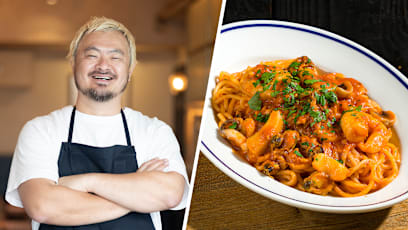
After the success of their three-month fish ramen pop-up Yet To Name Ramen at Orchard Plaza, foodie Leon Chua, 52, aka @uncle_lim_chiak on Instagram, and finance professional Hoe Lon (left in pic above), 50, are back with another noodle concept in the same ground-floor space.
This time, it’s udon.
Opening on October 7, Nekobushi Udon is a 14-seat udon bar that the duo are launching with Japanese chef Koki Miyoshi (right), 45, of popular Craig Road irori and oden izakaya Hearth. Irori is a traditional Japanese style of cooking over a sunken hearth. Before starting Hearth in 2023, he helmed oden izakaya Kamoshita.
No part of this story or photos can be reproduced without permission from 8days.sg.

Why Yet To Name Ramen didn't continue
Despite Yet To Name Ramen being a “success”, the pop-up ended its run on July 27 as planned.
Hoe Lon tells 8days.sg it was full until its final day, with the team selling around 90 bowls a day towards the end, up from 50 when they first started in May.
But keeping its $15 ramen affordable while maintaining the quality of the ingredients proved difficult. The eatery offered just two bowls: a lighter shoyu-based ramen topped with sashimi-grade fish, and a richer fish paitan-style ramen.
Financially, the pop-up “roughly broke even”, says Hoe Lon.
“Attendance was never the problem, each session did well. What we didn't do was push for more sessions to cover the fixed costs. At $15 a bowl, the maths only works if you open often enough.”
Another reason for moving on was chef-partner Hirofumi Imamura, former chef-owner of upmarket Sentosa kappo restaurant Imamura, which closed in August 2025. He was turning his attention to projects in Japan and Bali.
So rather than make Yet To Name permanent, Leon and Hoe Lon decided to try something new.

They’ve been courting chef Koki for years
Nekobushi is a collaboration that has been years in the making.
Leon says that he and Hoe Lon have wanted to work with chef Koki “from the first taste of his food” back in his Kamoshita days, but jokes that he was a “difficult Japanese chef to court”.
“For many years, we have been saying, ‘Come on, let’s do something,’” says Leon. “Kokisan is finally willing to work with us, [so] we jumped on that wagon for sure.”
As for the name Nekobushi, it combines neko (cat), kombu (kelp) and bushi (dried fish) — inspired by cat-loving Koki and the ingredients in his dashi.

Why udon?
It was chef Koki who suggested udon, which remains relatively niche here.
He reckons typical udon, which usually consists of a “simple broth plus some tempura topping”, can be a little too plain for Singapore palates compared to richer ramen.
His approach at Nekobushi sits somewhere in between. The dashi remains light, but different oils and fats add depth and fragrance without making it as rich as ramen.
“It makes the taste stronger and more fragrant than regular udon,” he explains.

Noodles of different shapes and textures
And don't expect the usual thick, chewy noodles.
Like pasta, udon comes in different shapes and textures that can be paired with different sauces, broths and toppings.
For Nekobushi, chef Koki developed his own noodle recipe with a local supplier. His freshly made udon is thinner and flatter, with a smooth, slippery texture and a slight chew, like inaniwa udon.
“I prefer a thinner noodle,” he says. “The texture is very smooth, and [goes] with the broth as well.”
More varieties will be introduced as the menu evolves.

Starting with two udon dishes
For now, though, Nekobushi is keeping things simple. It will launch with just two udons — a lighter kitsune udon (beancurd udon) and a more robust gyu udon (beef udon).
Both feature the same thin, kway teow-like noodles and dashi made with four types of dried fish — bonito, sardine, mackerel and flying fish — as well as kombu.
Each bowl also comes with a single broad, squarish piece of udon — which reminded us a little of kway chap — for some textural contrast.
Eventually, the team hopes to build a repertoire of around five or six udons, though not all will necessarily be available at the same time.
Sides will also be introduced later, including chef Koki’s popular oden, as well as rice bowls and onigiri.
For a start, diners can expect to see chef Koki behind the counter at Nekobushi for the first few weeks, before he splits his time between the udon bar and Hearth.

Kitsune Udon, $14.80
The lighter of the two is chef Koki’s take on kitsune udon, a classic Japanese udon topped with fried beancurd.
His version comes with not one but two types of beancurd from Japan — a thick, plump one from Niigata Prefecture and a crisp, airy version from his hometown of Ehime.
The former is soft, fluffy and slightly sweet, soaking up the dashi like a sponge, while the Ehime beancurd offers a nice contrast with its light, crispy texture.

It’s a relatively simple bowl, deliberately so. Koki wants the kitsune udon to showcase the noodles and dashi without too many competing flavours.
The umami dashi is light and clean-tasting, though the beancurd adds some richnes

Gyu Udon, $18.80
We prefer the punchier, more robust gyu udon, served with the same noodles and dashi.
Inspired by Osaka’s kasu udon, chef Koki’s version comes with simmered slices of beef short rib, chunks of crispy wagyu beef small intestine and a carpet of chopped leek and chives.

Shiok wagyu intestines
But it’s the wagyu fat that really sets this bowl apart.
The intestines are deep-fried to render their fat, which is then heated and poured over the finished udon. It sizzles on contact, releasing a rich, beefy aroma and adding a little tableside drama

The crispy intestine is added on top — almost like the beef equivalent of the fried pork lard you might find on a bowl of noodles.
The result is richer and more aromatic than the kitsune udon. The slightly fatty beef adds heft, while the intestine brings a satisfying crunch, though those who aren’t fans of leeks and chives might find their punchy flavours a little overwhelming.
There’s also a slice of lemon on the side, which we recommend adding midway to cut through the richness.
Nekobushi Udon opens Oct 7 at #01-36, Orchard Plaza, 150 Orchard Rd, S238841. Open Wed – Sat, 5.30pm to 8.45pm; Sun 11.30am to 2.45pm, or until sold out. Closed on Mon & Tue. Reservations and more info via website and Instagram.
Photos: Nekobushi Udon, 8days.sg
No part of this story or photos can be reproduced without permission from 8days.sg.
Watch Now
Related Stories


Shopping